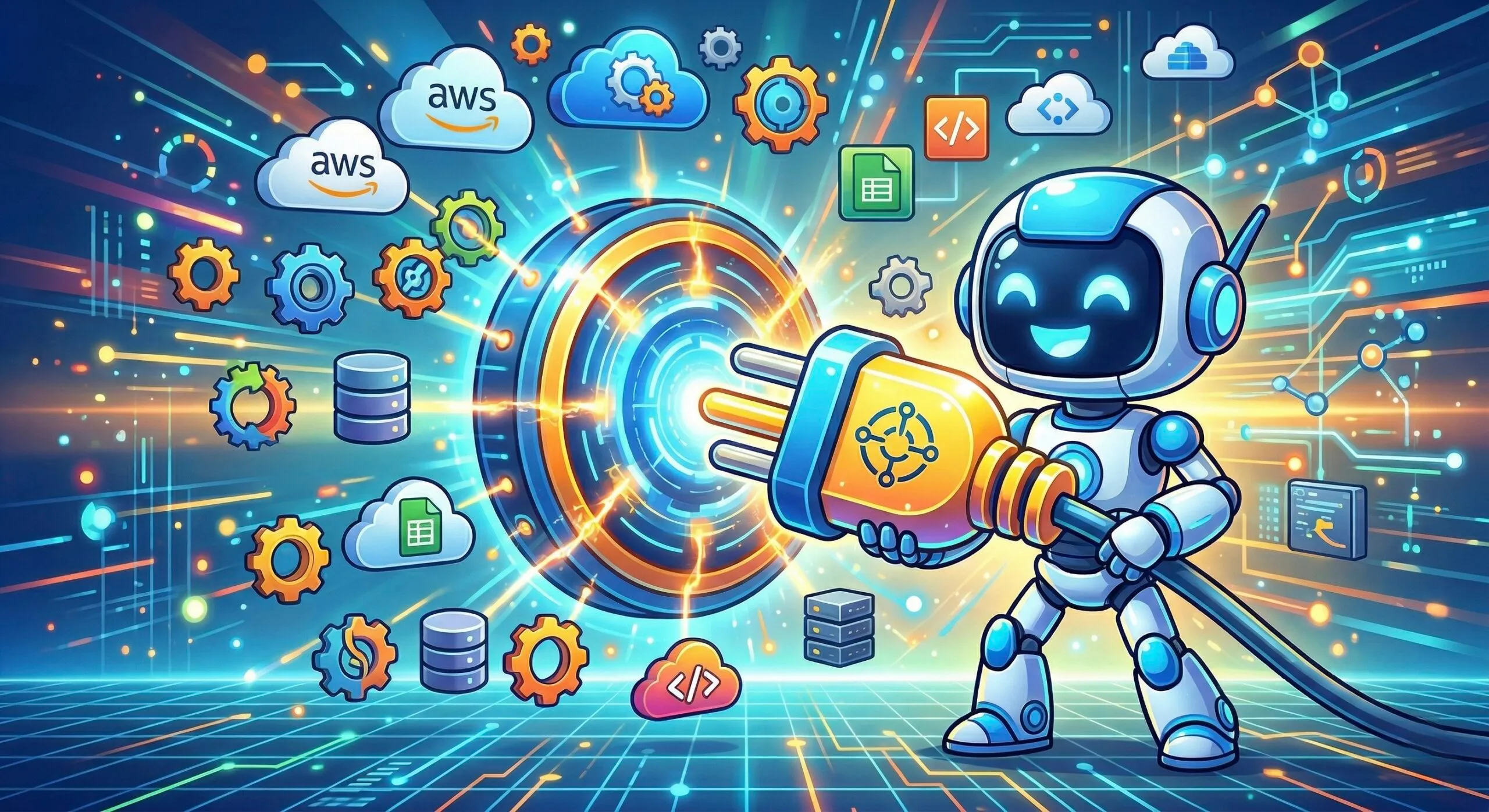
Imagine hiring the most gifted strategic mind in the world. They possess off-the-charts cognitive ability, deep domain comprehension, and can synthesize complex patterns at lightning speed. But there is a glaring problem: they are locked inside a windowless room with no phone, no internet access, and can only communicate via paper slips pushed beneath the door. Worse yet, you speak English and they only communicate in an obscure 4th-century dialect.
That scenario mirrors the tragedy of many enterprise AI agent initiatives today. Organizations deploy extraordinary frontier models, yet these models remain isolated from live operational systems. The Model Context Protocol (MCP) emerged to dismantle those walls. If your technology roadmap in 2026 is not actively designing around MCP, you are effectively assembling museum-grade technical debt.
The Enterprise Challenge: The War of Tooling Silos
Until recently, bridging an AI agent with internal business data (an Amazon S3 bucket, a transactional PostgreSQL database, or your Jira instance) resembled assembling custom furniture with mismatched parts. Developers were forced to author bespoke point-to-point connectors for every single tool. Want the model to query Slack? Build a connector. Want it to read Salesforce? Build another connector.
This created brittle, high-maintenance architectures where operational ROI dissolved into plumbing maintenance. In engineering cultures driven by operational efficiency, maintaining isolated silos is unviable. It is the architectural equivalent of keeping ten different remote controls for a single television.
The Breakthrough: MCP as the USB-C of Artificial Intelligence
flowchart LR
    A[AI Agent / Host LLM] <-->|Standardized MCP Protocol| B[MCP Server Gateway]
    B <--> C[(Databases / PostgreSQL)]
    B <--> D[Cloud S3 / Drive]
    B <--> E[External APIs / Slack / CRM]
Remember when consumer electronics required unique proprietary cables for every single peripheral before USB standardized connectivity? The Model Context Protocol represents that exact standardization moment for enterprise AI.
MCP is an open standard that allows any AI model host (Anthropic Claude, OpenAI, local models) to interface with external tools, prompts, and resources through a standardized, plug-and-play communication protocol.
The core architectural shift is profound: value does not reside in the model weights alone, but in the strategic context bridge constructed toward your enterprise data. With MCP, engineering teams stop writing custom transport adapters and start designing high-level workflows. You transition from digital pipefitter to distributed systems architect.
The Operational Blueprint: MCP Implementation Framework
To implement an enterprise MCP strategy with maximum ROI and security, follow this foundational four-step roadmap:
1. Data Source Inventory
Catalog high-leverage data sources (PostgreSQL, AWS S3, internal knowledge bases). Avoid attempting to connect everything simultaneously; prioritize the integration points generating the highest operational friction.
2. Serverless MCP Gateways
Host lightweight MCP servers on serverless container infrastructure (such as AWS Lambda or AWS Fargate). They remain cost-effective, scale on demand, and isolate data access boundaries cleanly.
3. Dynamic Context Layering
Rather than stuffing thousands of static tokens into the prompt context window, configure MCP tools so the agent requests granular information strictly when required. This drastically reduces token consumption, cuts latency, and boosts reasoning accuracy.
4. Zero-Trust Security & Auditability
MCP enables transparent auditing of tool calls and data access. Enforce granular IAM permissions and never grant an autonomous agent unrestricted administrative access to sensitive production databases.
Conclusion: Engineering Action Over Hype
Intelligent enterprise automation is never about deploying the flashiest conversational bot; it is about building dependable systems that solve real business problems using verifiable operational data. The Model Context Protocol provides the standardized foundation to achieve that without compromising architecture or exploding budgets.